
by Iqbal M. Khan, M. Zaheer Asghar, Asfand Ahmed Khan and Aleena Nouman
The purpose of this study is to analyze the Intentions of Kalasha towards Entrepreneurship using Ajzen’s Theory of Planned Behavior. Being the indigenous minority, the community faces a challenge for survival. This provides an excellent opportunity for the researchers to exploit the circumstances and study the intentions of such a community towards Entrepreneurship. For this reason, primary research was conducted where Entrepreneurial Intentions Questionnaire (EIQ) and detailed interviews were conducted from the Kalasha people to explore their intentions towards Entrepreneurship. The results exhibit sound intentions by the people to start a venture of their own. For Kalasha, the dilemma remains the same for the Kalasha like many Indigenous communities of the world. These include: a lack of start-up capital and infrastructure, negligible governmental support and an improper education system in the geographical area. All of these problems are resulting in cultural and social annihilation of the Indigenous Kalasha.
Introduction
Pakistan is a nation rich in cultural diversity. Each culture enjoys a particular identity and charm. Out of these cultures, one stands out as unique in many ways and resides in Kalash Valley. The indigenous concept of the Kalash is regarded as sensitive and culture oriented. UNESCO also recognizes the significance of supporting indigenous communities in recuperating their dignity and enabling them to transmit their distinctive knowledge, values and ways of life to future generations. This valley is situated in the Hindu Kush range of mountains between Chitral and Afghanistan. Chitral is a district of Khyber-Pakhtunkhuwa province in the north-west of Pakistan. The entire Indigenous Kalash constitutes around 6000 people living in this particular mountainous area in three valleys: Bumburet, Rumbur and Birir. The people claim themselves to be the decedents of General Shalak Shah who was a General in Alexander’s army. They are known to be rich in their culture, rituals, customs, and festivals. On religious grounds, they are known as ‘Kafirs’ (Atheist) that belong to ‘Kafirstan’ – ‘Place of Kafirs’. Being Indigenous to this terrain since two millenniums, they offer a virgin opportunity to researchers to study Entrepreneurship in its cultural context and entrepreneurial aspects. In olden times, farming and livestock were the major source of income and wealth. However, now they are converting to cash based economy and farming and livestock remain part of their subsistence economy. The residents have also started providing their homes as guest-houses for tourists to reside in to augment income. But tourism has decreased since the September 11, 2001 incident. Currently, many factors have been realized to affect the entrepreneurial intentions of people in Kalash. This vastly affects the education standards, and overall economic and social wellbeing of the region. This research papers seeks to find out the how these intentions affect the motivation levels of possible entrepreneurs in the region. It must be noted that factors stated in the paper relate to both internal and external characteristics. An array of well known models has been used to help analyze the situation currently at hand. The data collected from primary and secondary research has been sub grouped into various categories to find out the level of differences for each factor with intentions. With a rich history, and cultural values and diversity, it seems those residing in Kalash simply need a small push to get them motivated towards Entrepreneurship. They have the necessary resources, but do not have the knowledge as to how to utilize them to attain the benefits of business management. By analyzing this situation, the paper seeks to provide an insight of the psychology of the people of Kalash and how they can seek prosperity through the means of Entrepreneurship.
Purpose
The theme of this study is to identify the intentions which act as key drivers for motivation for entrepreneurial practices in the Valley. This research paper aims to add knowledge and literature in examining.
- The impact of self – efficacy and how it affects entrepreneurial intentions amongst Kalasha people.
- The extent to which social and cultural norms hinder to progression of entrepreneurial intentions amid those in Kalash Valley.
Research Methodology
It’s a mix type of research in which qualitative and quantitative approach has been adopted for the study. Quantitative research approach was utilized for conducting survey in three valleys of Kalash; Rumbur; Brir; and Bumburiat. Population of Kalash is 6000 while selected sample size comprised of 60 persons. Entrepreneurial Intention Questionnaire was utilized in the study with the permission of the author. It was translated into Urdu language as well as guides were hired for filling up the questionnaire from target audience as most of the audience were illiterate so unable to read or write. To overcome the deficiency of reading and writing problem of the target audience qualitative research approach was also utilized. Interviews were conducted from 10 Kalasha entrepreneurs. Interviews were conducted with the help of open ended questionnaires. Responses of the interviews were recorded and then transcribed for analysis.
Quantitative data was analyzed with SPSS software. Correlation, t-test and regression statistics was used in the study for analysis of the quantitative data.
Literature Review
Peredo et al (2004) state that though generalizations have been made on Entrepreneurship, there is much left to understand about Indigenous Entrepreneurship. It has been noted that there is a strong need within indigenous communities to attain economic and social development. Clearly, there is a need for Indigenous Entrepreneurship. The main factor for indigenous people is that they wish to retain as much of their culture and norms as possible whilst succeeding in the market. This can be applied to the people of Kalash Valley as they possess a need for progression, yet manage to become more and more sidelined by the majority.
Connecting Entrepreneurship to the Indigenous communities of the world is not an easy job. There are a plenty of questions which need to be looked at for establishing concrete relations of the subject matter. The first aspect includes the distinctive facets of Entrepreneurship of the indigenous people which is influenced by their culture, beliefs and norms; or not. On the other hand, as it is an established principle about the non-indigenous entrepreneurial activities – financial sustainability. It is another question which is to be looked at to conclude some association with Indigenous ones. As a matter of fact, including the physiological aspect is of mere importance. Determining the difference between different cognitive processes amongst such aboriginals is another aspect, which must cause their motivation and start up efforts to deviate from non-indigenous ones for an entrepreneurial venture to pevail and relevant decision making.
Berkes and Adhikari (2005) define that enterprises set by indigenous communities contain a profit motive; however, this does not override the needs of the community. These enterprises look at sharing profits, creating employment, utilizing resources, and developing talents. This aids in creating entrepreneurial intentions for the indigenous communities since, for most, it is a matter of survival.
There is a strong relationship between Culture and Entrepreneurship, where many factors from the cultural side affect Entrepreneurship. Thus, it makes evident for research to be conducted in the same manner in the future. Simultaneously, this is because of the worldly aspect of the said relationship at different points across time. On the other hand, many of the factors from environment including social-political forces, technological advancements, legal and economic scenarios may also influence culture-entrepreneurship relationship.
Entrepreneurship has been given importance in every part of the World. Due to cultural, technological and social transformations, it has been recognized as one of the most important feature of economic growth and stability. Zainol et al (2010) emphasized on Entrepreneurial Orientation (EO). In contemporary times, EO has been identified as a key factor for a firm’s stability and economic viability. According to Stevenson & Jarillo (1990), research explores that Entrepreneurial Orientation fosters upward sloping growth of a firm. Entrepreneurial Orientation injects innovation, practical approach and risk taking characteristics in a society for entrepreneurship promotion, which in relation enhances growth. As a matter of fact, Entrepreneurship Orientation comprises of the basic factors are the key to success. There is a need of encouragement of Entrepreneurial Orientation policies and course of action to be put into practice. Such important factors equip a society to be able to survive in the competitive world like today and attain sound growth prospects. Using the concept, the Indigenous Kalasha entrepreneurship diverges from that of the western context of entrepreneurship. Hence, western entrepreneurial paradigms are not appropriate to be applied in Kalasha or Indigenous Kalasha entrepreneurship. Zainol et al (2010) suggests that there should be efforts exercised to endorse cultural philosophies which can be utilized to determine success or failure indicators. It is also emphasized that developing an entrepreneurship culture on agrarian community like Kalasha is a difficult and a challenge to be faced. The role of government seems to be crucial; as the project and initiatives by it in upholding Kalasha entrepreneurs should be permitted to be maintained.
Entrepreneurship and Intention has a close relationship. Entrepreneurship is a mindset that enables to avail the opportunities over all the threats. As a matter of fact, to scan the external environment and identify opportunities is a purely intentional procedure. The present literature and studies explored that predicting entrepreneurial actions on the basis of demographic variables and personality traits has ended in narrow clarifications. The under lying principle using such variables is leaned on the assumptions that people having alike traits and characteristics would behave in same entrepreneurial manner. On the other hand, models bases on intentional theories have been considered as the best substitute to forecast entrepreneurial actions (Krueger and Carsrud, 1993). (Ajzen, 1993) argues that intentions are visualized as instant antecedents of actual behavior. New businesses do not emerge quickly. These are appearing over time and consist of a long planning done by the entrepreneur. Hence, entrepreneurship resembles to planned behavior for which models built on intentions are best (Bird 1988; Katz and Gartner 1988). On the same grounds, one of the models is Shapero’s Entrepreneurial Event Model (SEE) (figure 1), in which intentions for entrepreneurship is dependent upon:
(Shapero, 1982)
- The perception of desirability shown by an individual
- The tendency to act on an entrepreneurial opportunity
- The perception of feasibility
Shapero concluded that entrepreneurial venture creations are as a result of situational and socio-
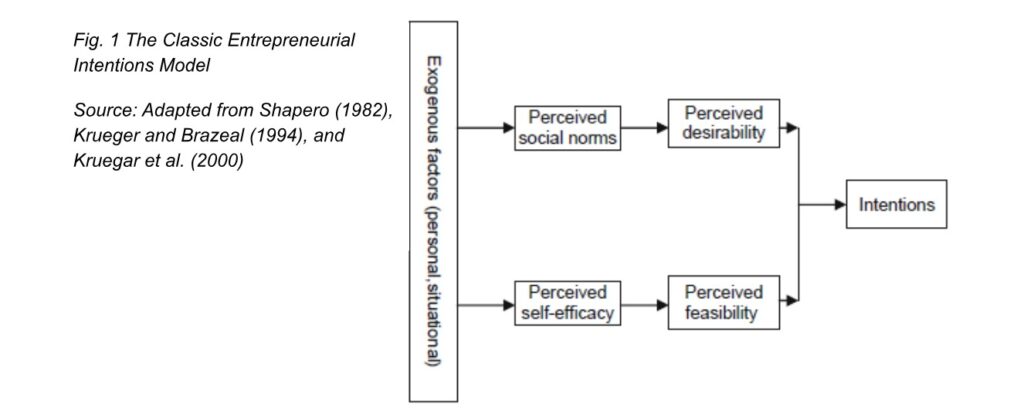
cultural factors. It was also concluded that an individual’s behavior remains the same until a point in time where the inertia breaks; e.g job loss, winning a lottery or getting inheritance etc. (Carsrud et al)
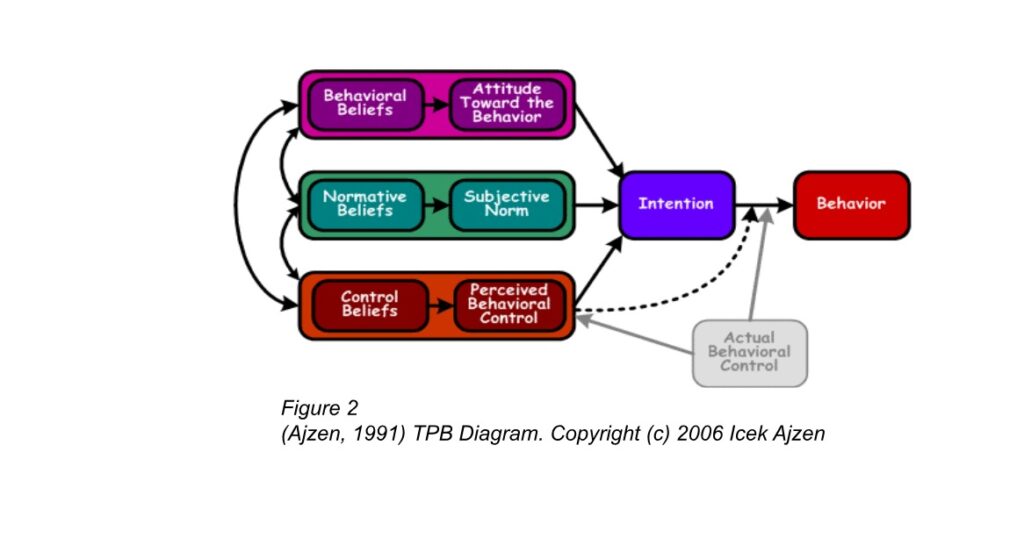
Another sound model in Entrepreneurial Intentions is based on Ajzen’s theory of planned behavior (Ajzen, 1991). According to the theory, intentions are elucidated by:
- An individual’s attitude towards the behavior
- The subjective norms
- And the individual’s perception towards behavioral control
Intentions are conjured up as instantaneous antecedents of actual behavior (Ajzen, 1991). Also, building an attitude towards a certain idea which drives a specific behavior must be accompanied by a conviction; that it will result in definite outcomes (Fishbein and Ajzen, 1975; Boyd and Vozikis, 1994). An Individual’s attitude towards the behavior is of mere importance. It is an entrepreneur’s attitude towards the venture that defines the boundaries of his success.
Social factors from the external environment have also been given much weight by Ajzen. He included ‘subjective norms’ another factor which drives intentions of an individual towards entrepreneurship. These are the perceived social values which create a social force to engage or restrict one in a behavior. Social forces also influence an individual’s tendency to act entrepreneurially. These social pressures play an important role in motivating or de-motivating an individual towards Entrepreneurship, hence constructing or destructing the intention. On the other hand, an individual’s perception towards behavioral control also demarcates the boundaries of intentions. Behavioral control is a function of an individual’s attitude towards a behavior and the subjective norms towards that behavior, which is the center of attention in expecting the actual behavior.
Ajzen’s model has been given wide scale acceptance by research scholars due to its wide scale applicability in determining entrepreneurial intentions. It gives holistic, contemporary and relevant circumstantial insights in knowing the right factors which influence entrepreneurial intentions. It accounts for socio-economic factors which can influence entrepreneurial activity. As discussed by Ajzen, Behavioral beliefs tie the behavior of curiosity to predictable results. It is also the subjective likelihood that the behavior will result in a convinced outcome. It was assumed that subjected values of such outcomes determine an attitude towards a behavior; which is the level to which presentation of a behavior is positively or negatively valued.
Next comes the ‘Normative Beliefs’, which are the perceived behavioral anticipations of closely related family members or groups (e.g. spouse, friends, doctor, collogues etc); which build a social pressure referred to as ‘Subjective Norms’.
Control beliefs are related with the apparent presence of factors that may make easy or break an act of a behavior. According to Ajzen, control beliefs if combined with the perceived power of each control factor conclude the established perceived behavioral control.
All of the above factors play individual roles in forming an individual’s intentions which certainly transforms into entrepreneurial behavior.
On the basis of the literature reviews, the following research questions were derived;
Q1. What is the relationship of Kalasha attitude towards entrepreneurial intentions?
Q2. What is the impact of Kalasha subjective norms on entrepreneurial intentions?
Q3. What is the impact of Kalasha perceived behavioral control on entrepreneurial intentions?
Qualitative Analysis
a- The influence of attitudes on entrepreneurial intention
Entrepreneurial intentions are strongly influenced by attitude towards entrepreneurship. Without the positive attitude towards Entrepreneurship as a career it is not possible to decide to run one’s own business. Attitude towards Entrepreneurship provides a desire for freedom and self actualization.
Interview #6: The reason I stated my own venture was the attraction of running my own business. This gave me the confidence and courage necessary to oversee my business.
Interview #4: The feelings of freedom and independence were the reasons I initiated my own business. Such an initiative helps one’s future become more secure and reward-seeking through one’s own efforts.
b- The impact of subjective norms (SN) on entrepreneurial tart up
Kalasha entrepreneurs whose parents were already entrepreneur acknowledged the positive impact of their parents on their decision to become an entrepreneur. Their family back ground as an entrepreneur gave them awareness to choose Entrepreneurship as career opportunity.
Interview #2: I was encouraged to start my own business by my family as my father also had his own business. They encouraged and helped me to open an independent business venture.
A number of interviews from Kalasha entrepreneurs showed that most of the entrepreneurs who selected entrepreneurship as a career have friends or family members already doing work as entrepreneur. Their friends and family members act as role model for them to start business venture.
Interview #7: I started my own business using my friends as examples of success. My father and friends encouraged me to pursue my idea.
Concerning the influence of family, friends and the surrounding environment of entrepreneurial intentions it can be expressed from the interviews from Kalasha entrepreneurs that family background and surroundings play an important role in the promotion of entrepreneurial intentions. Therefore a person with entrepreneurial minded parents is more inclined towards Entrepreneurship. While it cannot be determined that children of entrepreneurs will become entrepreneurs.
Interview# 8: This respondent wished for is children to receive the best education as possible. He does not expect them to join his business in the future and allows them to choose any line of employment they wished to work in.
c- The influence of perceived behavioral control on entrepreneurial intention
Perceived Behavioral Control (PBC): Perceived behavioral control has a great impact on entrepreneurial intentions. Strong relation of perceived behavioral control seems to be a necessary part of the entrepreneurial start up. This paper shows that the entrepreneurs interviewed in Kalash have a strong level of self efficacy to start up an entrepreneurial activity. It was observed in their interview they had a strong belief of success even they did not have clear idea of their business future when they started business.
Interview# 07: I was sure I would be a success but the future direction of business processes was ambiguous to me.
Although Kalasha entrepreneurs had no idea of business management and planning, they were sure that they would be successful in business in their future. It was reflected in an interview of a Kalasha entrepreneur who realized that he had no idea about steps necessary to manage a business but one thing that he asked himself was that he would be able to do it by himself successfully.
Interview#5: I began my venture believing in myself to do well. I ignored the basic needs and concepts of running a business. I knew I could do it.
It was observed in Kalasha entrepreneurs that they have strong self efficacy for starting a business by understanding that they can manage the business well. They can tackle the issues coming in their way as hurdles. Strong perceived behavioral control is required for starting a business even you have strong attitude towards entrepreneurship but without such a confidence it is not possible to initiate a business.
Interview # 4: One cannot initiate a business without a belief of success. Willpower is crucial. When I started my business, I had a strong belief in myself to do well in the future through hard work and effort.
Quantitative Data Analysis
The sample includes 45 Kalsah and 15 Kalasha from the same valley, 41 of them were married and 41 person were unmarried. The sample size includes 11 entrepreneurs and 49 job holders while there were 46 males and 14 females as indicated below in the given Table 1

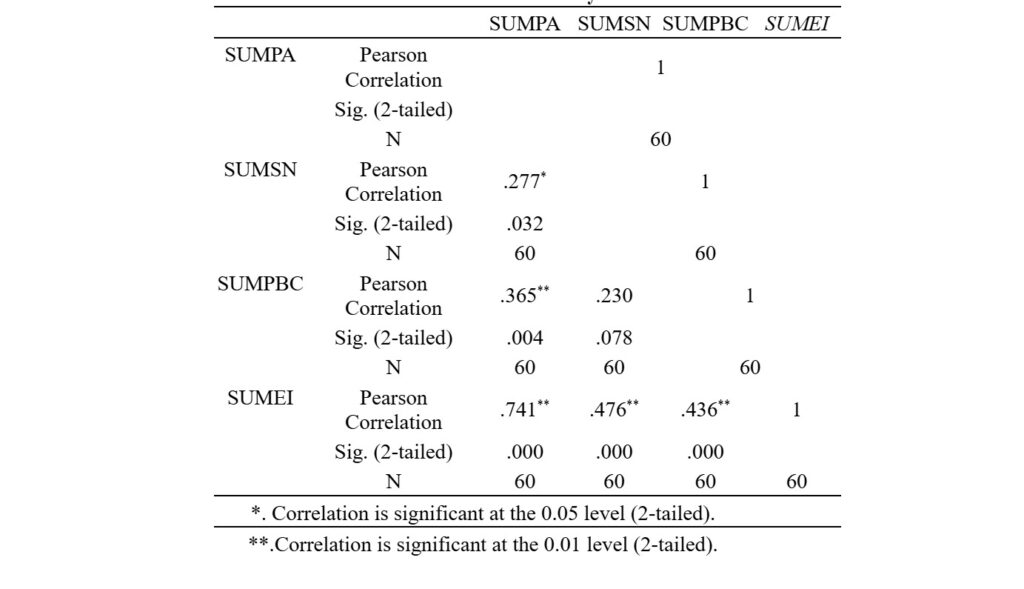
The relationship between entrepreneurial intentions and personal attitude is .741 at significant level 0.01 that shows there is a strong relationship between personal attitude and entrepreneurial intentions. The relationship between subjective norms and entrepreneurial intentions is also positive but it is not so much strong as the correlation value is .476 at significant level of 0.01. The relation between perceived behavioral control and entrepreneurial intentions is also positive but not so much strong as it is shown by correlation value .436 at significant level of 0.01.
Independent t-test for Kalasha Male and Female Entrepreneurial Intentions
H0; there is no significant difference between entrepreneurial intention of Kalsha male and female.
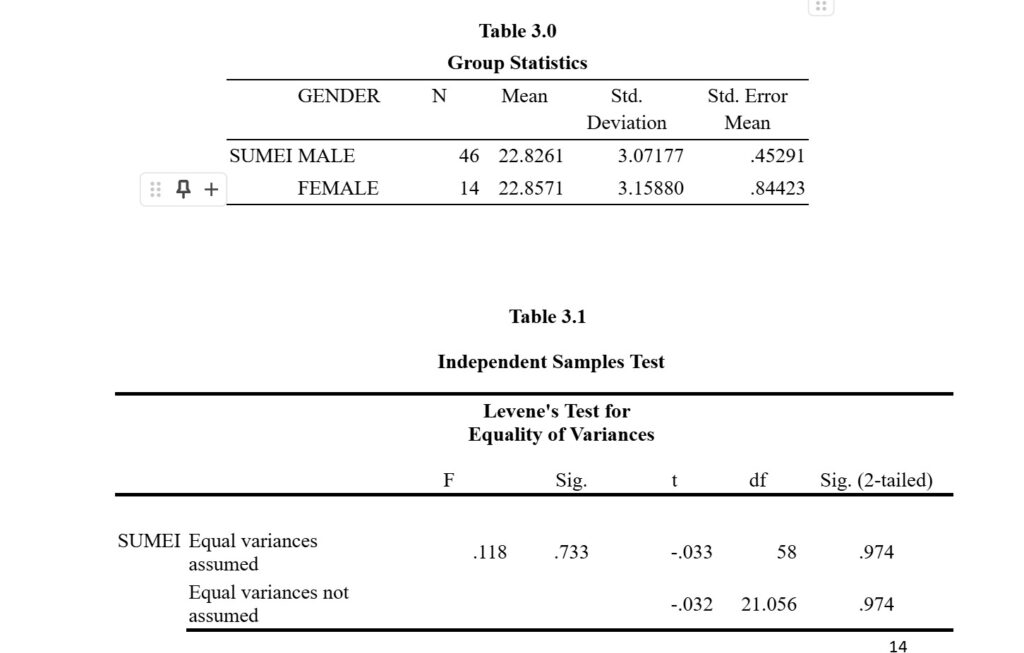
Independent t-test was run to find out the significant difference of the male and female intentions. Leven’s test for equality of variance shows non significance of .733. So equal variance was assumed and it was observed that there was a no significant difference in the scores for Male Kalash (M=22.82, SD=3.07) and female Kalash (M=22.85, SD=3.15) conditions; t (58)=-0.33, p = .974. These results suggest that there is no significant difference between Male Kalash and female kalash entrepreneurial intentions and this does not reject the null hypothesis.
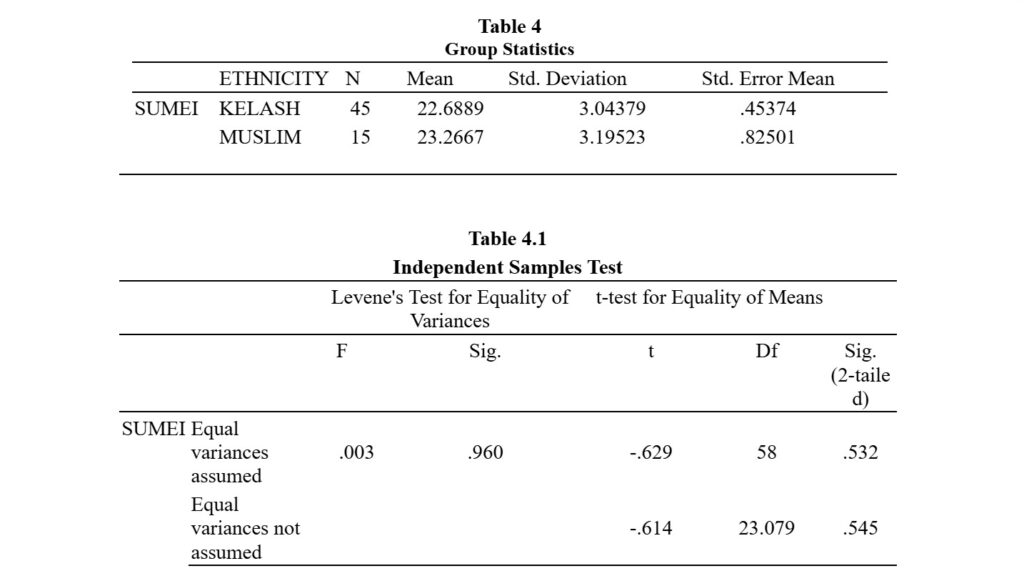
An independent-samples t-test was conducted to compare entrepreneurial intentions of kalsah and non Kalash living in the same valley. There was a no significant difference in the scores for Kalash (M=22.6, SD=3.04) and non Kalash (M=23.26, SD=3.19) conditions; t (23.07)=-6.14, p = .545. These results suggest that there is no significant difference between Kalash and non kalash entrepreneurial intentions and this does not reject the null hypothesis.
Regression Analysis
H0B1,B2,B3 : Personal Attitude, Subjective Norms and Perceived Behavioral Controls have insignificant impact on Entrepreneurial Intentions on Kalasha people
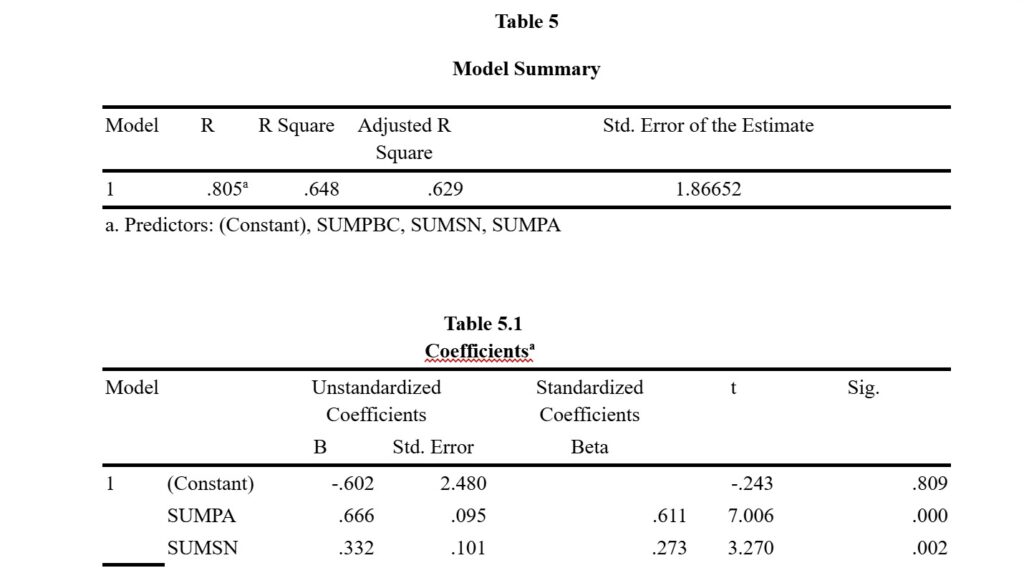

Ho(B1): Personal Attitudes has insignificant impact on Entrepreneurial Intentions in Kalasha people
T Critical value of the model comes out to be 2.0032 at 95% confidence interval. On the other hand T Statistics of the variable comes out to be 7.006. This means that we would reject Ho as (t stat > t critical).The said variable is significant it even at 100% confidence interval as P value also comes out to 0.00. H0 is rejected and Personal Attitudes has significant impact on Entrepreneurial Intentions in Kalasha people.
Ho(B2): Subjective Norms have insignificant impact on Entrepreneurial Intentions in Kalasha people
T Critical value of the model comes out to be 2.0032 at 95% confidence interval. On the other hand T Statistics of the variable comes out to be 3.270. This means that we would reject Ho as (t stat > t critical). This means Subjective Norms have significant impact on Entrepreneurial Intentions in Kalasha people
Ho(B3): Perceived Behavioral control have insignificant impact on Entrepreneurial Intentions in Kalasha people.
As T Critical value of the model comes out to be 2.0032 at 95% confidence interval. On the other hand T Statistics of the variable comes out to be 1.752. This means that we would reject H1 and accept H0 as (t critical > t stat). But we see that, the same variable has P Value of 8.5%, which tends to show significant impact of Perceived Behavioral Control towards Entrepreneurial Intentions of Kalasha people. So, the variable is significant at 90% confidence interval.
H0B1,B2,B3 : Personal Attitude, Subjective Norms and Perceived Behavioral Controls have insignificant impact on Entrepreneurial Intentions on Kalasha people
The F critical value comes out to be 4.1519 at 99% confidence interval, Whereas F stat in the regression model is computed equals to 34.371. Thus, we tend to reject Ho :
The model gives a healthy R Square value for the first hand date taken from Kalash valley. It explains that around 65% of the variability in the Entrepreneurial Intention’s data is explained by all the independent variables in the model; which are Personal Attitude, Perceived Behavioral Controls and Subjective norms of the Kalasha people.
The standard error of the estimate shows that the standard deviation of the residuals is 1.86652. The same value can be used to construct prediction limits for newer observations by selecting the Reports option from the text menu. On the other hand, The Mean Absolute Error (MAE) of 1.20977 is the average value of the residuals.
According to Statgraphics, the DW test (Durbin-Watson) statistic test is used to determine if there is any significant correlation evident based on the order in which they are occurring in the data under consideration in which they occur in your data file. Since the DW value is greater than 1.4, there is probably not any serious autocorrelation in the residuals.
Regression Equation Suggests:
EI = -0.601977 + 0.666221*PA + 0.140398*PBC + 0.331806*SN
The regression equation shows that all the components of Aijzen’s model, that are Personal Attitude, Subjective Norms and Perceived Behavioral Controls have positive relation towards Entrepreneurial Intention in the people of Kalash. In other words, from the statistical model, the researchers get direct proportionality of all the components of Aijzen’s model with entrepreneurial intentions of the Kalasha
The above statistical model shows that EIQ based on Aijzen’s model shows promising results in determining Entrepreneurial intentions in Kalasha people. Questions were asked on three broad aspects, which are Personal Attitudes, Perceived Behavioral Controls and Subjective Norms. On the whole, the model shows that all of the said variables show strong correlation with Entrepreneurial intentions in Kalasha people with 99% confidence interval.
On the other hand, evaluating individually, the researchers come to the result that Personal Attitudes and Subjective Norms are highly significant to Entrepreneurial Intentions for the people of Kalasha, having 95% confidence interval. As far as Perceived Behavioral Controls are concerned, it is also significant to Entrepreneurial Intentions but as 90% confidence interval. This is because the Kalash people confronted with environment and circumstances that do not provide for jobs are faced with entrepreneurial venture options only. When they reach this point of decision it was found that they did not hesitate to go for a business venture. Self efficacy is on the lower side on the fact that they lack in risk taking propensity
Conclusion and Suggestions
Through the research conducted, it was observed that there are high entrepreneurial intentions among Kalasha. These intentions are due to the environment that provides the people with business opportunities in the form of agriculture to grow seasonal crops such as wheat and barley. They also grow fruit trees, for example; grapes, pear, apricot, almond, pine, and nutshells. Their dependency on herd forming also enhances their self employment intentions. In the forest area there are trees, which are cut down trees for the purpose of furniture making and using wood in architect; however there is a large chance for the forestry industry to diminish soon due to deforestation. There are no other major sources of employment. This factor enhances the people’s self-dependency on the natural resources of Kalash Valley.
The people’s attitude to run a business is positive towards entrepreneurial intentions since their ancestors were mostly entrepreneurs. This positive attitude is also due to awareness of self actualization and freedom that is given to them by Entrepreneurship. When someone starts his own business activity in Kalash, he/she is appreciated by his community and family as Kalasha norms promote a self employment attitude. Kalasha people are used to run their own business generation by generation so parents, relatives and friends helps each other morally, financially in start up of a new business. Males and females both work to support their families.
The level of entrepreneurial intentions amongst the males and females were equal as both males and females work to financially support their households. The females help males in businesses such as farming, herding, shop keeping and hotel management. Handicrafts and dresses produced by Kalasha women are also a source of earning. The designs of such handicrafts are unique and innovative as they are solely derived from the Kalasha culture. These artifacts are appreciated by tourists. Income from tourism is also a source of income for these people, however, after the 9/11 incident, this has seen a drastic downfall. They have no access to the larger city markets and therefore, these handmade cultural goods cannot be exported and sold. This hinders the livelihoods of the people of Kalasha Valley.
The perceived behavioral control to run their business is not as strong as it should be. They lack self efficacy in this sense because of the certain reasons observed in the qualitative interviews and observations. These people are restricted to the Valley and lack exposure to the outside world. It is against their cultural norms to stay outside the Valley for a long tenure due to the lack of financial and social support. Hence, they lack the knowledge of the modern culture and way of life. There was also a natural disaster in the form of a flood, whereby most of the people lost their business property. This affected the people’s self efficacy towards Entrepreneurship. The lack of educational and training institutions aggravates the low levels of Business and Entrepreneurship knowledge; which then affects the level of businesses taking form. There are no proper roads to link Kalasha Valley with the district city of Chitral. The lack of transportation channels, such as roads, also minimizes the people’s self efficacy to run a business because they have no easy access to market place to sell their products.
Policy makers can make policies on the basis of the research to enhance conducive entrepreneurial activity amongst youth of the region. It will help in socio – economic growth of the region by enhancing entrepreneurship and understanding mind set of Indigenous culture.
There are numerous researches on Kalasha culture but there is dearth on Kalasha indigenous entrepreneurship. This study will add to the literature previously researched about antecedent of entrepreneurial inclinations. It has also initiated discussion on new topics for research in future, for example; entrepreneurship policy and socio-economic development, and characteristics of successful indigenous Kalasha entrepreneurs.
Due to the accumulated issues being faced currently by the people of Kalash, a number of suggestions have been put forward to help bring about entrepreneurial activity in the region. Provided these are followed appropriately, Entrepreneurship can thrive in the region.
- The Government and local council must ensure that all merit goods are in place for the public to avail. These include basic infrastructure (telephone lines, mobile signal boosters, roads, hospitals, and electricity), education (high schools in Rambur and the placement of a college or university in Kalasha Valley), a tourism department that will work to enhance the image of the region – making it more tourist friendly, and Parliamentary law (to help preserve the culture and enhance the level of security and reasoning. This also includes local and national representation in the political system of Pakistan). A development in infrastructure will enhance business opportunities in these people that will ultimately enhance entrepreneurial intentions.
- An Entrepreneurship Development Institute must be set up in Kalash Valley. This should offer specialized programs in teacher training and development, Entrepreneurship Education, and act as an advice forum for the enrolled students. Such Non Government Organizations can work to enhance entrepreneurial intentions in the Valley. Donations can be acquired from national and international sources. These funds can be used to support the youth’s education and help entrepreneurs set up businesses.
- A Vocational Training Center and business incubators should be placed to help mould the workforce to be skilled and independent. By focusing on enhancing the market of non-timber products (such as mushrooms, walnuts, pine nuts, apples, honey, pears, and handicrafts like dresses and necklaces), the outside markets can be targeted directly, whereby these goods can be sold at high prices to gain a larger profit.
- The local people must be given the opportunities to visit and work in larger cities to allow them to be more exposed to other regions and people. This will help them gain more acceptance and attention in Pakistan.
- Both Government and commercial banks must set up a micro-finance facility in Kalash Valley to allow the people to gain access to short term loans to begin their enterprises. These loans must promote the set up of businesses.
- The Media can play a role by using print media to communicate development and support in the region. This can be done through the means of magazines, trade journals, posters, pamphlets, banners, brochures. Electronic media may also be used, such as the internet, television documentaries, and the radio. Local exhibitions (puppet shows, fashion shows etc) can also help promote the region. These promotional means can promote entrepreneurs in Kalash Valley to promote an entrepreneurial mindset amongst the region.